
Introduction
As the Internet of Things (IoT) continues to expand across industries such as agriculture, utilities, environmental monitoring, and industrial automation, organizations require reliable and scalable connectivity solutions. LoRaWAN has emerged as one of the leading technologies for long-range, low-power wireless communication, enabling devices to transmit data over several kilometers while maintaining years of battery life.
At the center of every LoRaWAN network is a Network Server. One of the most widely adopted open-source solutions available today is ChirpStack.
This article explains what ChirpStack is, how it works, and why it has become a popular choice for organizations deploying LoRaWAN networks.
What is ChirpStack?
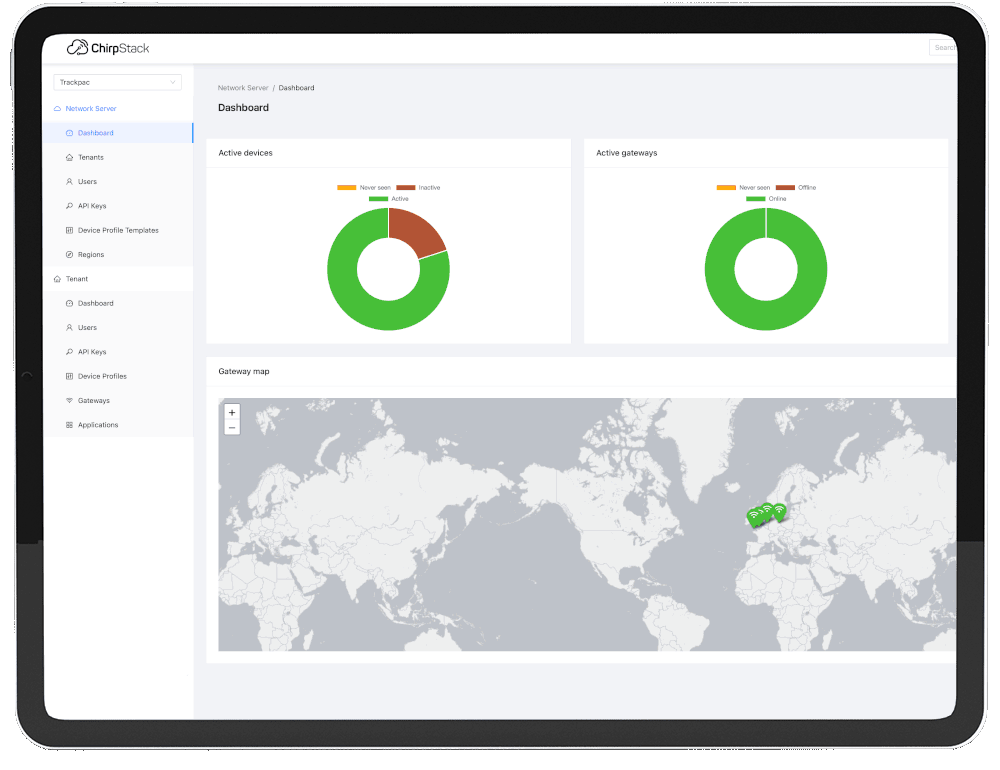
ChirpStack is an open-source LoRaWAN Network Server designed to manage communication between LoRaWAN devices, gateways, and applications.
It acts as the core component of a LoRaWAN network by:
- Authenticating devices
- Processing uplink and downlink messages
- Managing gateways
- Forwarding application data
- Enforcing LoRaWAN security mechanisms
ChirpStack supports deployments ranging from small pilot projects to large-scale industrial networks consisting of thousands of connected devices.
Key Components of a LoRaWAN Network
A typical LoRaWAN deployment consists of four main components:
End Devices
Sensors, meters, trackers, and monitoring devices installed in the field.
Gateways
Gateways receive wireless transmissions from LoRaWAN devices and forward them to the Network Server through an internet connection.
ChirpStack Network Server
ChirpStack processes messages, validates devices, handles encryption, and routes data to applications.
Applications
Dashboards, analytics platforms, SCADA systems, databases, or custom software that consume the device data.
Why Organizations Choose ChirpStack
Open Source
Unlike proprietary solutions, ChirpStack offers complete transparency and flexibility. Organizations maintain control over their infrastructure and avoid vendor lock-in.
Scalability
ChirpStack is capable of supporting deployments ranging from a few devices to thousands of sensors distributed across multiple gateways and locations.
MQTT Integration
The platform integrates seamlessly with MQTT, one of the most popular messaging protocols in IoT.
Security
ChirpStack implements LoRaWAN security standards, including device authentication and encrypted communications.
Active Community
As one of the most established open-source LoRaWAN projects, ChirpStack benefits from continuous improvements and a strong user community.
Challenges of Running ChirpStack Yourself
Although ChirpStack is free and open source, operating a production-ready deployment requires technical expertise.
Organizations must manage:
- Linux servers
- Database administration
- Security updates
- Monitoring
- Backup procedures
- Disaster recovery
- Infrastructure scaling
For many businesses, these operational tasks become a distraction from their core objectives.
Benefits of Managed ChirpStack Hosting

Managed hosting eliminates the complexity of infrastructure management.
Benefits include:
- Fast deployment
- Automatic updates
- Infrastructure monitoring
- Data backups
- Technical support
- High availability
- Predictable monthly costs
This allows organizations to focus on their IoT applications rather than server administration.
Conclusion
ChirpStack has become one of the most trusted open-source LoRaWAN Network Servers available today. Its flexibility, scalability, and strong ecosystem make it an excellent choice for organizations deploying IoT solutions.
Whether you are building a small proof-of-concept or managing thousands of field devices, ChirpStack provides the foundation needed to create reliable and secure LoRaWAN networks.